
More product photos
Vintage Bendable Skeleton Figure 🦴 Poseable Halloween Toy Bendy Skeleton, 1980s-1990s
$20.00
Shipping and any applicable taxes are shown at checkout.
The details
5 1/2" x 4 1/4" ~ hand-sized, and he stands up on his own two feet.
🦴 Seven of these fought Jason in 1963, and it took four and a half months to film
Not this one — mine is a dime-store toy and nobody's name is on it. But the trick inside it is the same trick, and that is the thing I love about these. Bend an arm, bend a leg, stand him up in a new pose and he stays exactly where you put him. Something soft over something that holds a bend. That is a bendy toy, and it is also, in principle, a stop-motion armature.
When Ray Harryhausen shot the skeleton fight in Jason and the Argonauts, he had three actors going against seven skeletons, each one with five limbs to move in every single frame — at least thirty-five separate adjustments, by hand, before he could click the shutter once. Some days he got thirteen or fourteen frames. Under a second of finished film in a day's work. Four and a half months for a sequence that runs about three minutes, and it is still the scene every stop-motion animator points at. Those skeletons were eight to ten inches tall, built on thin metal armatures with latex and cotton wool worked over the bones.
Mine is five and a half inches and cost somebody pocket change. Same idea, bottom shelf.
💀 What you are actually getting
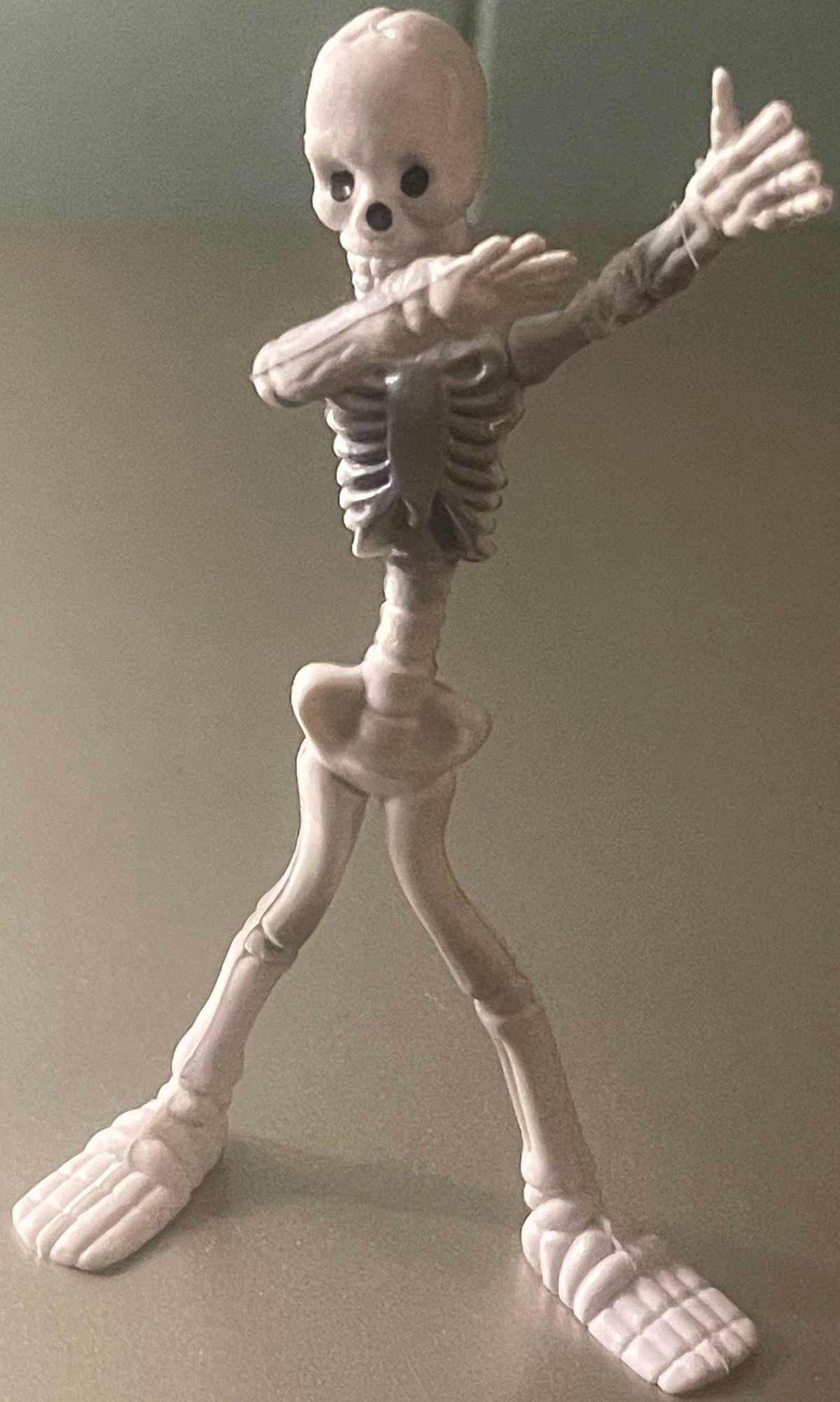
- A small moulded plastic skeleton, bone white, with a grey wash brushed down into the ribs, the spine and the pelvis so the detail actually reads instead of going flat.
- Black paint in the eye sockets and the nose. The skull has a moulded suture line across the crown and a full set of upper and lower teeth.
- Five separate fingers on each hand, not a mitten. And the feet — huge, flat, paddle-shaped things with the toes and the metatarsals moulded right in. That is the joke of the sculpt: anatomically fussy from the neck up, cartoon from the ankles down.
- He bends and he holds it. Look at my three pictures — that is the same figure three times, arms crossed, hands up, then both arms overhead with a leg forward. He went wherever I put him and stayed there.
- New old stock. Never played with, never hung on a string, never left too close to a candle.
And here is the honest bit: there is not one mark on him. No maker, no brand, no copyright line, no patent number, no country. I went over the shins, the back of the pelvis, the feet and the back of the skull at magnification — the usual places a factory hides a mark — and there is nothing there. What looks like tiny lettering on the shin is the sculpt of the tibia and fibula catching a shadow. So I cannot tell you who made him, and I would rather say that than make something up.
🔧 Something soft over something that bends
The bendy toy is one of those quietly clever bits of engineering that nobody thinks about. A wire armature gets buried inside the rubber or the PVC, and that is the whole product — the wire does the holding, the soft skin does the looking. Earlier ones were foam latex over bendable wire, which is why so many of the old ones have gone hard and crumbly in a box somewhere.
The category has been running for sixty-odd years. Lakeside Industries was turning out bendies in the 1960s — collectors list a Gallant Yank soldier in 1966 and a Popeye in 1967. Bendy Toys over in Britain did the Muppets in 1977 and 1978 and Sesame Street through the 1980s. Just Toys made Bend-Ems the shorthand for the whole idea in the 1990s, and the name is still going. And underneath every one of those licensed, named, blister-carded figures there was an ocean of unbranded ones — skeletons, monsters, aliens, spiders — sold loose out of a bin near the register with no card, no name and nobody's copyright on them. This little guy is one of those. Nobody was ever going to research him, which is exactly why I am doing it.
🎃 Why a plastic skeleton is a big deal to a certain kind of kid
Before the twelve-foot yard skeletons and the animatronics, Halloween decorating meant a rack of rubbery little monsters near the register and whatever you could talk a parent into. A skeleton was the pick of the litter, because a skeleton could do things — get posed climbing a bookshelf, get stood on the windowsill facing out so the mail carrier got a jump, get tucked into a lunchbox to be found at school.
And then something happened that turned a small posed skeleton into a thing a whole generation went looking for on purpose. Walter Wick and Jean Marzollo made I Spy Spooky Night for Scholastic, and Wick built the whole book around a photographed toy skeleton — a trickster who beckons you room to room and turns up somewhere on every single page. Wick bought two Newport dollhouse sets to build those rooms and rebuilt them both to suit. Scholastic later put out an early reader called I Spy A Skeleton. Millions of kids spent their childhood hunting a little toy skeleton across a photograph. Mine is not that skeleton and carries no name at all — but if you grew up hunting one, I understand completely why this one stops you.
🕯️ The lore
- Collectors of this era's Halloween odds and ends tell it that the little bendy skeletons were more often won than bought — grab-bag prizes at a school carnival, party favors at a Halloween birthday, the thing the one good neighbour dropped in your bag instead of another fun-size candy bar. That is the story handed down, and it is why almost nobody remembers where theirs came from.
- Which is also why the packaging never survives. Nobody keeps a card off a two-for-a-quarter toy. Grown adults go looking for "that little bendy skeleton I had" with no name to type into a search box — only the size, the pose and the feel of it in a hand.
- Old-timers in the novelty trade will tell you the bin by the register outsold the shelf every October, and that the unbranded stuff moved fastest because it cost the least. No catalogue was ever kept of any of it.
❓ Questions people ask me
Does he actually bend, or did you just pose him for the pictures? He bends. All three pictures are the same figure, moved. He holds whatever you set.
Any marks on him at all? None. I looked hard, including at magnification, and I will not invent one.
Why do these matter if nobody made a record of them? That is exactly why. The stuff that got catalogued takes care of itself. Nobody wrote a line about the cheap bin toy that half the country's kids owned, so if we do not keep it, it is gone.
Grab him while I have a few left. He will go out packed properly and quickly, and thank you for helping me keep this stuff from disappearing. 💀
Delivery & returns
Items from different suppliers may arrive in separate packages. Shipping costs and any available delivery estimates are shown at checkout.
Shopping for a specific date? Contact us before ordering so we can help check supplier timing.